The furnace clicks, hums for eight seconds, then goes quiet. It does it again. And again. You’re standing in a cold basement in Brookside at 11pm in January bracing for a four-figure number.
Here’s the reframe most Kansas City homeowners need: the majority of furnace repairs are cheap, often under $300, and the real financial risk is not the repair bill. It’s whether the technician finds a cracked heat exchanger, because that single finding turns a service call into a replacement decision and can legally end with your furnace shut off and tagged before they leave.
Furnace repair cost in Kansas City, MO averages $231, with most repairs falling between $96 and $370. Ignitors, flame sensors, and thermostats run $80 to $250. Blower motors run $300 to $900. Heat exchangers run $1,800 to $3,500 and usually mean replacing the furnace instead. Repairs need no permit in Kansas City, but a furnace replacement does, and Spire’s $200 to $300 rebates apply only to new high-efficiency equipment.
Key Takeaways
- Kansas City furnace repair averages $231, with most homeowners paying between $96 and $370.
- Ignitors and flame sensors are the most common failures, costing just $80 to $250 installed.
- A cracked heat exchanger forces a shutdown, and repair rarely makes financial sense on older furnaces.
- Kansas City’s median home was built in 1969, which drives venting and draft-related furnace problems.
- Spire rebates pay $200 to $300 on new furnaces only, never on repairs to existing equipment.
Furnace Repair Cost in Kansas City, MO: The Real Numbers
Most furnace repair articles quote a national range so wide it tells you nothing. Kansas City has actual local data, and it is more reassuring than most homeowners expect.
Angi’s Kansas City furnace repair data puts the local average at $231, with most repairs landing between $96 and $370. That is dramatically lower than what people brace for, and it reflects a simple reality: gas furnaces fail at their cheap parts far more often than their expensive ones.
The pieces that break most often are the ignitor, the flame sensor, and the thermostat. Those are consumable components with a known service life, and all three are inexpensive. The pieces that cost real money, the heat exchanger and the gas valve, fail far less often and usually only on furnaces past 15 years old.
Labor and Diagnostic Rates in Kansas City
Kansas City HVAC labor generally runs $50 to $150 per hour, and emergency or after-hours work runs $150 to $215 per hour. Diagnostic fees sit at $89 to $149 at most local companies.
That after-hours spread is worth doing math on. A flame sensor cleaning at 2pm on a Wednesday and the identical job at 11pm on a Sunday can differ by more than the part itself costs. If your house is holding a livable temperature and you have space heaters, waiting until morning is often the cheaper call. If the house is dropping toward freezing or you have infants, elderly residents, or pipes at risk, do not wait.
Furnace Repair Cost by Part in Kansas City
This table is what actually predicts your bill. Prices are installed, parts plus labor.
| Failed component | Typical installed cost | How often it fails |
| Flame sensor (clean or replace) | $80 to $250 | Very common, often first suspect |
| Hot surface ignitor | $100 to $250 | Very common |
| Thermostat | $150 to $500 | Common |
| Capacitor | $150 to $400 | Common |
| Pressure switch | $200 to $400 | Common on 90%+ furnaces |
| Draft inducer motor | $400 to $900 | Moderate |
| Blower motor (PSC) | $400 to $900 | Moderate |
| Blower motor (ECM variable speed) | $600 to $2,300 | Moderate |
| Gas valve | $400 to $1,000 | Less common |
| Control board | $400 to $1,200 | Less common |
| Heat exchanger | $1,800 to $3,500 | Rare, usually a replace decision |
HomeGuide’s 2026 furnace repair data supports the low end here, pricing ignitor replacement at $100 to $250 and flame sensor work at $80 to $250. Blower motor replacement runs $300 to $900 depending on whether the motor is a single-speed PSC or a variable-speed ECM, and ECM motors on modern high-efficiency furnaces sit at the top of that range.
The practical read: if your technician names anything in the top eight rows of that table, you are almost certainly under $1,000. If they say heat exchanger, stop and read the next section carefully.
The Heat Exchanger: Why This One Repair Changes Everything
A cracked heat exchanger is not a normal repair conversation. It is a safety conversation with a price attached.
The heat exchanger is the metal wall separating your home’s breathing air from the combustion gases produced when the furnace burns natural gas. When it cracks, carbon monoxide can mix into the air moving through your ducts. That is why technicians who find a confirmed crack shut the furnace off at both the electrical switch and the gas valve and tag the unit, rather than leaving the choice to you.
Angi’s guidance on red-tagged furnaces is direct about this: a red-tagged furnace is unsafe to operate and must be repaired or replaced before it runs again. A crack cannot be patched or welded on a residential furnace.
Here’s the math nobody enjoys. A heat exchanger runs $1,800 to $3,500 installed. Homeyou’s Kansas City data puts furnace installation in Kansas City at roughly $1,480 to $1,800 for the install labor, and full furnace replacement in the metro commonly lands in the $3,500 to $6,500 range for a mid-efficiency system. Paying $2,800 for a heat exchanger in a 19-year-old furnace means spending most of a replacement cost on one component inside a system already near the end of its life.
Two things protect you here. First, ask whether the heat exchanger is under manufacturer warranty. Many carry 20-year or lifetime heat exchanger coverage on the part, which does not cover labor but removes the largest line item. Second, ask to see the crack. A camera inspection or combustion analysis reading should back the diagnosis. A reputable Kansas City contractor will show you the evidence without being asked.
Why Kansas City’s Housing Stock Drives Furnace Repair Bills
This is the piece generic cost guides cannot write, and it explains a lot of local service calls.
The median Kansas City home was built around 1969, and roughly 21 percent of the housing stock predates 1940, according to city-data’s Kansas City housing figures. Walk through Hyde Park, Northeast, Waldo, or the older sections of Brookside and you are looking at homes designed around gravity furnaces and masonry chimneys, later retrofitted two or three times over.
That history creates furnace problems you will not read about in a national article.
Orphaned water heaters. When an 80 percent AFUE furnace gets replaced with a 95 percent condensing model, the furnace stops using the old masonry chimney and vents through PVC out a sidewall. The gas water heater is left venting alone into a flue sized for two appliances. It drafts poorly, condenses moisture inside the chimney, and deteriorates the liner. Homeowners then blame the new furnace for a problem that is actually a venting mismatch.
Chimney draft on older 80 percent furnaces. Plenty of Kansas City homes still run mid-efficiency furnaces venting into unlined or deteriorating chimneys. Poor draft causes flame rollout, nuisance lockouts, and premature heat exchanger stress.
Condensate freeze on high-efficiency furnaces. Condensing furnaces produce liquid condensate that drains through PVC. When that line or the exhaust termination runs through an unheated Kansas City crawlspace or exits on a north-facing wall, a hard freeze can block it. The pressure switch senses the blockage and locks the furnace out. The homeowner gets no heat on the coldest night of the year, and the actual repair is often clearing ice, not replacing a part.
Undersized or leaky returns. Older KC homes retrofitted with forced air frequently have return ducts too small for a modern blower. That restricts airflow, overheats the heat exchanger, and shortens its life. It is a duct problem presenting as a furnace problem.
All 4 One Heating & Cooling works these homes constantly across Manheim Park, Troost Avenue, Woodland Avenue, and out into Raytown, Independence, and Gladstone. The failures repeat because the building stock repeats.
Kansas City Gas Safety Rules and Permit Requirements
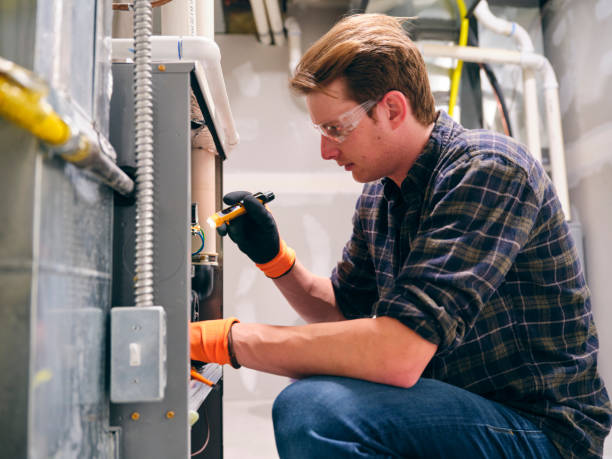
Two rules matter before you approve furnace work in Kansas City, and one of them is a safety rule you should act on before calling any contractor.
If You Smell Gas, Call Spire First, Not an HVAC Company
If you smell rotten egg odor, hear hissing near the furnace or gas line, or a CO alarm sounds, leave the house and call Spire’s emergency line at 800-887-4173 from outside. Spire is the natural gas utility for the Kansas City metro and responds to leak calls at no charge. An HVAC contractor is the right call for a broken furnace. The utility is the right call for a suspected gas leak.
Repairs Need No Permit. Replacement Does.
Standard furnace repairs, including ignitors, sensors, motors, valves, and boards, do not require a permit in Kansas City. Replacing the furnace does. Kansas City requires a mechanical permit for furnace replacement through the City Planning and Development Department, applied for through CompassKC, with residential mechanical permit fees generally running $75 to $250.
A furnace replacement also triggers inspections, and a licensed contractor handles both the permit and the scheduling. Kansas City’s Permit Center sits on the 5th floor of City Hall at 414 E 12th Street, phone (816) 513-1500, if you need to verify a permit was actually pulled on your property.
The Cold Weather Rule Protects Your Gas Service, Not Your Furnace
Worth knowing during furnace season: Missouri’s Cold Weather Rule runs November 1 through March 31 and bars regulated utilities including Spire from disconnecting heat-related service for nonpayment when temperatures are forecast below 32 degrees. The Missouri Public Service Commission expanded that protection to a 72-hour forecast window, up from 24 hours.
That rule keeps your gas on. It does nothing about a furnace that has stopped working, which is a separate problem with a separate fix.
Spire Rebates Apply to New Furnaces, Not Repairs
Homeowners ask about this constantly, so let’s be precise. Spire pays rebates on new high-efficiency equipment. There is no rebate for repairing a furnace you already own.
If your repair quote pushes you toward replacement, Spire’s Missouri furnace rebates pay $200 for a gas furnace rated 92 percent to 95.99 percent AFUE and $300 for 96 percent AFUE or higher. Two details matter: self-installs are prohibited, so the work must be done by a licensed contractor, and your application must be postmarked within one year of the install date. Rebates arrive as a Spire prepaid Mastercard six to eight weeks after approval. You can apply at spireenergy.com/rebates or call 833-841-4639.
One correction worth making, because outdated advice is still circulating: the federal 25C tax credit that paid up to $600 toward a qualifying high-efficiency furnace expired December 31, 2025. If a 2026 quote leans on a federal furnace credit, that contractor is working from stale information.
Repair or Replace Your Kansas City Furnace?
The common shortcut is the $5,000 rule: multiply the furnace’s age by the repair cost, and if the result exceeds $5,000, replace it. A $600 repair on an 8-year-old furnace scores 4,800 and passes. The same repair on a 15-year-old furnace scores 9,000 and fails.
It is a decent filter, but it misses two things that matter more in practice.
Failure clustering. A gas furnace typically lasts 15 to 20 years. When a furnace at year 17 needs a draft inducer, the control board and blower motor are usually not far behind. Three $700 repairs across two winters is a replacement you paid for in installments and never got.
Efficiency drag. A 1990s-era 70 to 80 percent AFUE furnace burns roughly 20 to 25 cents of every gas dollar into the chimney compared to a 96 percent model. Over a full Kansas City heating season that gap is real money, and it compounds every year you defer.
Practical framework for a KC home:
- Under 10 years old: repair almost anything short of a heat exchanger.
- 10 to 15 years: repair wear parts, run the $5,000 rule on anything over $800.
- Over 15 years: get a replacement quote alongside any repair quote over $600.
- Cracked heat exchanger at any age over 12: replace.
- Over 25 years old: you are past the design life. Budget for replacement before next winter regardless of what breaks.
Five Ways Kansas City Homeowners Overpay for Furnace Repair
Most overpaying has nothing to do with a contractor charging too much. It comes from decisions made before the technician arrives.
Skipping maintenance, then paying emergency rates. A flame sensor cleaned during a $99 fall tune-up costs a fraction of the same job at 11pm in January at $150 to $215 per hour. Annual furnace maintenance in Kansas City catches ignitors, sensors, and draft problems before they strand you.
Not checking the filter first. A clogged filter causes overheating, limit-switch lockouts, and short cycling that look exactly like a component failure. Check it before you book. It is free and it resolves a real share of no-heat calls.
Approving a repair without the replacement number. On any furnace over 12 years old, get both figures on the same visit. A contractor unwilling to give you both is not giving you enough to decide with.
Never checking warranty status. Many furnaces carry 10-year parts coverage if registered at install, and heat exchangers often carry 20-year or lifetime part coverage. That does not cover labor, but it can strip $600 to $2,000 off a bill. Find the model and serial plate inside the furnace door before you approve anything.
Paying for refrigerant-style guesswork. If a technician wants to replace parts sequentially without a firm diagnosis, that is your cue for a second opinion. A gas furnace is a diagnosable sequence: call for heat, inducer, pressure switch, ignitor, gas valve, flame sense, blower. A competent tech can tell you exactly where the sequence stops.
What to Do Before You Approve Furnace Repair in Kansas City
Furnace repair cost in Kansas City, MO is not really one number. It is a fork in the road. Down one path is a $150 flame sensor and a warm house by dinner. Down the other is a heat exchanger finding that ends with your furnace tagged and a replacement decision you did not plan for this month.
You control which conversation you have more than you think. Check the filter. Note whether the furnace is short cycling, failing to ignite, or blowing cold. Find the model and serial number. Then ask your technician for four things: the exact component that failed, the installed price in writing, the replacement quote for comparison if the furnace is over 12 years old, and confirmation of warranty coverage.
All 4 One Heating & Cooling has been servicing Kansas City furnaces for 26 years, holds Kansas City, MO and Johnson County contractor licenses, and answers the phone 24 hours a day for the no-heat calls that arrive at the worst possible time. You get the diagnosis explained in plain terms and an upfront price before any work starts, including the honest replacement math when that is the better call. Call (816) 699-8366 or book furnace repair in Kansas City, MO for same-day service.
FAQ
How much does furnace repair cost in Kansas City, MO?
Furnace repair in Kansas City averages $231, with most repairs falling between $96 and $370 according to Angi’s local data. Diagnostic fees run $89 to $149. Common repairs like flame sensors and ignitors cost $80 to $250 installed. Blower motors run $300 to $900, and a heat exchanger runs $1,800 to $3,500, which usually points toward replacement instead.
Do I need a permit to repair a furnace in Kansas City?
No. Furnace repairs do not require a permit in Kansas City. Replacing the furnace does. Kansas City requires a mechanical permit through the City Planning and Development Department via CompassKC, with residential fees generally between $75 and $250, plus inspections. Your licensed contractor pulls the permit and schedules the inspection.
What happens if my furnace gets red-tagged in Kansas City?
A red tag means a technician found a safety hazard, most commonly a cracked heat exchanger that can leak carbon monoxide into your air. The furnace is shut off at the electrical switch and gas valve and must not run until it is repaired or replaced. Ask to see the evidence and check whether the heat exchanger is still under manufacturer warranty before deciding.
Is it worth replacing a 30-year-old furnace in Kansas City?
Yes, in almost every case. A gas furnace is designed to last 15 to 20 years, so a 30-year-old unit is well past its service life and likely running at 60 to 70 percent AFUE. You are burning roughly a third of your gas bill up the chimney, parts availability is a problem, and heat exchanger risk climbs sharply. Put the repair money toward replacement and claim the Spire rebate.
Can I get a Spire rebate for repairing my furnace?
No. Spire rebates apply only to new qualifying high-efficiency equipment, not repairs. If you replace, Spire pays $200 for a 92 to 95.99 percent AFUE gas furnace and $300 for 96 percent AFUE or higher. Self-installs do not qualify, and the application must be postmarked within one year of installation.
Why does my Kansas City furnace keep shutting off in cold weather?
On a high-efficiency condensing furnace, a hard freeze can block the condensate drain or the exhaust termination, and the pressure switch locks the unit out for safety. On an older 80 percent furnace venting into a masonry chimney, poor draft in extreme cold causes similar lockouts. Both are common in Kansas City’s older housing stock, and both are usually fixable without replacing major parts.