Mini split repair costs in Kansas City are not high because the equipment is exotic. They’re high because most homeowners approach ductless with assumptions borrowed from central air, and those assumptions cost money. Every expensive mini split invoice traces back to one of five beliefs that sound reasonable and are wrong. Get those right and ductless mini split repair in Kansas City, MO is usually a few hundred dollars.
Most Kansas City mini split repairs run $105 to $800, with compressor replacement at $1,000 to $1,550 being the outlier that usually points toward replacement instead. The five costly assumptions: that any HVAC company can service ductless, that a recharge fixes low refrigerant, that a musty smell is a filter issue, that ductless needs no maintenance, and that one dead head means the system is finished.
Key Takeaways
- Most Kansas City mini split repairs cost $105 to $800 including parts and labor.
- Fewer local contractors service ductless, so a wrong diagnosis often gets paid twice.
- Mini split line sets leak at flare fittings, which is why recharges keep repeating.
- Kansas City’s old, duct-free housing stock is why ductless is common here.
- Component repairs need no permit, but new installs need mechanical and electrical permits.
What the Repairs Actually Cost
Setting the baseline before the corrections. These figures come from HVAC Pro Sales’ 2026 mini split repair cost breakdown, which separates parts from labor by repair type, with labor running $75 to $150 per hour.
A capacitor replacement lands at $105 to $200 and takes an hour or two. A thermostat or sensor repair runs $125 to $275. A fan motor is $200 to $400. A refrigerant leak repair, which is the most common real fault on ductless, runs $250 to $550 and takes two to four hours. A control board is $300 to $800, and a compressor replacement is $1,000 to $1,550 over three to six hours.
Add a diagnostic fee of $75 to $200, and expect emergency rates of $160 to $250 per hour if you’re calling on an August weekend. Now the five things that decide which of those numbers you end up paying.
Wrong Assumption One: Any HVAC Company Can Fix It
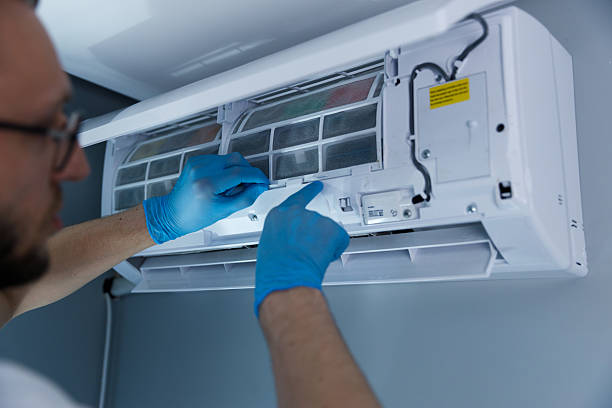
This is the expensive one, and it’s first for a reason. The costliest mini split repair in Kansas City is not the compressor. It’s the one where a company that mostly services furnaces and central AC misdiagnoses an inverter fault, replaces a working control board for $600, and you pay a second company to find the actual problem.
Central air runs on universal parts. Any supply house in the metro stocks a capacitor that fits half the systems in Kansas City. Mini splits run on inverter-driven boards matched to the specific model, with no universal equivalent, and they self-diagnose through error codes that mean nothing to someone who hasn’t worked with that brand.
Two questions before you book: do you service ductless systems specifically, and do you work on my brand. A company that hesitates on either is telling you something useful. Also retrieve the error code yourself before calling. It’s blinking on the indoor head or displaying on the outdoor board, it takes ten seconds, and it does more to shorten your repair than anything else you can do.
Wrong Assumption Two: If It’s Low on Refrigerant, Recharge It
A sealed system does not consume refrigerant. If the charge is low, it leaked, and on a mini split the leak has a predictable address.
Central AC line sets are brazed copper. Mini split line sets connect with flare fittings, mechanical joints tightened to a torque spec. A flare that wasn’t torqued correctly during installation will weep refrigerant slowly for years before anyone notices the cooling has fallen off. That’s the single most common real fault on ductless equipment in this market, and it’s why the “just top it off” approach fails so reliably.
Topping off buys you one season. Then you pay again, at a higher price per pound each year, because manufacturing of new residential R-410A equipment ended January 1, 2025 under the EPA’s HFC phasedown. Existing systems remain legal to run and service, but service refrigerant tightens and prices climb.
Insist on a leak search. Insist that any refrigerant added is listed on the invoice by type and by the pound. And confirm whoever handles it holds EPA Section 608 certification, which is federal law rather than a nicety.
Wrong Assumption Three: The Musty Smell Means a Dirty Filter
Rinsing the filter does nothing for the smell, and Kansas City homeowners routinely cycle through three or four filter cleanings before paying for the service they needed at the start.
The odor comes from biofilm growing on the blower wheel and evaporator coil inside the indoor head. Western Missouri sees 90 degrees or higher on 40 to 50 days in a typical year, per the Missouri Climate Center, and the humidity that comes with it keeps that indoor coil wet for months at a stretch. Wet metal in a dark plastic housing at room temperature is close to ideal conditions for growth.
The fix is a deep clean where the blower wheel comes out. It’s a maintenance job rather than a repair, it takes real time, and it is not something a filter rinse approximates. On a mini split older than three years in this climate, assume you need it rather than hoping you don’t.
Wrong Assumption Four: Ductless Doesn’t Need Maintenance
Mini splits get sold on the promise of simplicity, and homeowners hear that as maintenance-free. The equipment is simple. The maintenance requirement is not zero.
Two things need attention annually in Kansas City. The indoor coil and blower wheel, for the reason above. And the condensate drain, which on most mini splits is a gravity line running through the exterior wall with no pump and no float switch to protect you. When it clogs with algae, the water doesn’t back into a pan and trip a safety. It comes out the bottom of the head and runs down your drywall.
There’s a third item specific to this climate, and it’s about the outdoor unit rather than the indoor one. A mini split condenser in a snow market should sit elevated on a stand or wall bracket, high enough that defrost meltwater drains away and drifted snow can’t block the coil. Plenty of units across this metro were set flat on a ground pad by installers used to warmer markets, and those are the ones icing over every February. If yours ices repeatedly and the electronics test fine, look at how it’s mounted before you replace anything.
Wrong Assumption Five: One Dead Head Means the Whole System Is Done
On a multi-zone system, several indoor heads share a single outdoor unit. That architecture cuts both ways, and understanding which direction you’re facing changes the number significantly.
If a single indoor head fails while the rest of the system works, replacing that head is often the cheap and correct move. The expensive components live outside.
If the shared outdoor unit fails, the calculation inverts. A replacement condenser has to match every existing indoor head, and compatibility across model years is not guaranteed, which sometimes forces a full system replacement whether you wanted one or not. That’s the scenario where a $1,300 compressor quote turns into a much larger conversation.
Either way the threshold is the same one technicians use everywhere: replace when repairs exceed roughly half the cost of a new system, when the unit is past 10 to 12 years old, or when the compressor fails. A ductless install runs $2,000 to $14,500 depending on zones and complexity, with a national average near $3,000 for a straightforward single-zone job. Against that, a $1,300 compressor on a 12-year-old single-zone unit is already at the line, and a new system arrives with a current refrigerant and a fresh warranty.
Why Kansas City Has So Many Mini Splits in the First Place
Worth understanding, because it explains why the stakes are different here. Roughly 21 percent of Kansas City homes were built before 1940, with another 5 percent by 1949. Many of those houses were built with boilers and radiators and never had a duct system at all.
That’s why ductless heads are everywhere in Brookside, Waldo, Hyde Park, and the Northeast. When there’s no ductwork and no way to add it without opening plaster walls, a mini split is the only realistic path to air conditioning. The same logic covers the additions, sunrooms, converted attics, and finished basements that fill out these neighborhoods, where the original system was never sized for the added square footage.
The practical consequence: if the mini split is the only cooling in that space, a two-day parts delay in August is a genuine problem rather than an inconvenience. Confirm parts availability before approving any special-order component, and ask what the second trip costs.
The Permit and Rebate Facts
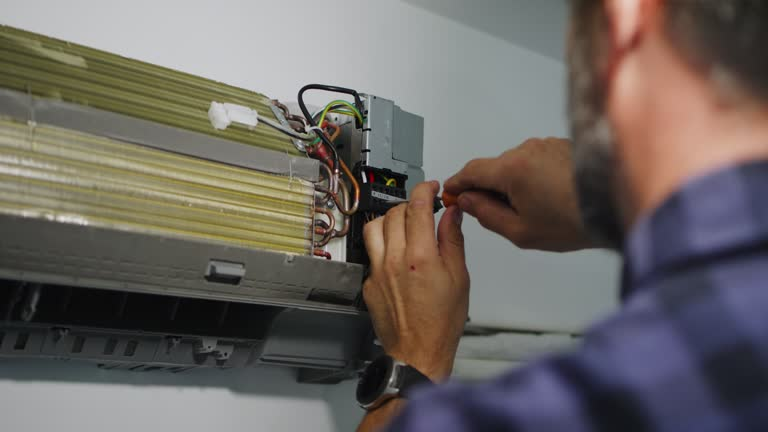
Repairs need no permit. Kansas City’s permit exemption list under Chapter 18, Section 18-16 exempts replacement of any part or assembly of an appliance that doesn’t alter its original approval, which covers capacitors, sensors, fan motors, and boards.
New installations generally need two permits, and this catches people. A new mini split needs a mechanical permit, and because it almost always requires a dedicated circuit, it needs an electrical permit too. Kansas City’s electrical exemption only covers minor repairs and fixture swaps where no circuit is altered or extended. Running a new circuit is an extension.
On rebates: Evergy pays toward new equipment only, never toward a repair. Its Missouri rebate chart has listed $200 for mini split air conditioners at SEER2 16 to 18 and $200 for heat pump mini splits, covering both replacements and new additions. One line in that chart is easy to miss and worth money: Spire natural gas customers are eligible for both the Evergy and Spire rebates on qualifying measures. Confirm current amounts with Evergy before planning around them, since program years change.
Getting a Mini Split Repair Right the First Time in Kansas City
Everything above reduces to a single principle: ductless fails differently than central air, so the instincts you built on a furnace and a condenser will point you wrong. Leaks live at flare fittings, not brazed joints. Smells live on the blower wheel, not the filter. Boards are proprietary, not universal. And the cheapest repair is the one where the first technician was the right technician.
Start by writing down the error code. Then find someone who services ductless as a matter of routine rather than as an exception.
If you’d rather not spend a July afternoon calling companies that turn down ductless work, All 4 One Heating & Cooling services mini splits alongside central systems, holds contractor licenses in both Missouri and Kansas, and handles ductless mini split installation in Kansas City, MO when a repair stops penciling out. Call (816) 699-8366 with the code ready.
FAQ
How much does ductless mini split repair cost in Kansas City, MO?
Most Kansas City mini split repairs cost $105 to $800 including parts and labor. A capacitor runs $105 to $200, a fan motor $200 to $400, a refrigerant leak repair $250 to $550, and a control board $300 to $800. Compressor replacement is the expensive outcome at $1,000 to $1,550, plus a $75 to $200 diagnostic fee.
Why does my mini split keep losing refrigerant?
Mini split line sets connect with flare fittings rather than brazed copper joints. A flare that was not torqued correctly at installation weeps refrigerant slowly for years. A recharge without a leak search buys one season, then you pay again at a higher price per pound as R-410A supply tightens.
Why does my mini split smell musty?
The odor comes from biofilm on the blower wheel and evaporator coil inside the indoor head, which is common in humid climates like Kansas City where the coil stays wet for months. Cleaning the filter does not address it. The blower wheel has to come out for a deep clean.
Do I need a permit for mini split work in Kansas City, MO?
Repairs need no permit, because Kansas City exempts replacement of any component part of an appliance from mechanical permitting. A new mini split installation typically needs both a mechanical permit and an electrical permit, since the outdoor unit requires a dedicated circuit and the city’s electrical exemption does not cover new or extended circuits.
Is it worth repairing a 12-year-old mini split?
Usually not if the compressor failed. Replace when the unit is past 10 to 12 years old, when repairs exceed half the price of a new system, or when it runs R-410A, since service refrigerant is getting scarcer and more expensive. A single-zone install often runs near $3,000, which a compressor job approaches quickly.